20110720

Jeremiah 16

1 Then the word of the LORD came to me: 2 “You must not marry and have sons or daughters in this place.” 3 For this is what the LORD says about the sons and daughters born in this land and about the women who are their mothers and the men who are their fathers: 4 “They will die of deadly diseases. They will not be mourned or buried but will be like dung lying on the ground. They will perish by sword and famine, and their dead bodies will become food for the birds and the wild animals.”

 5 For this is what the LORD says: “Do not enter a house where there is a funeral meal; do not go to mourn or show sympathy, because I have withdrawn my blessing, my love and my pity from this people,” declares the LORD. 6 “Both high and low will die in this land. They will not be buried or mourned, and no one will cut themselves or shave their head for the dead. 7 No one will offer food to comfort those who mourn for the dead - not even for a father or a mother - nor will anyone give them a drink to console them.
 8 “And do not enter a house where there is feasting and sit down to eat and drink. 9 For this is what the LORD Almighty, the God of Israel, says: Before your eyes and in your days I will bring an end to the sounds of joy and gladness and to the voices of bride and bridegroom in this place.
 10 “When you tell these people all this and they ask you, ‘Why has the LORD decreed such a great disaster against us? What wrong have we done? What sin have we committed against the LORD our God?’ 11 then say to them, ‘It is because your ancestors forsook me,’ declares the LORD, ‘and followed other gods and served and worshipped them. They forsook me and did not keep my law. 12 But you have behaved more wickedly than your ancestors. See how all of you are following the stubbornness of your evil hearts instead of obeying me. 13 So I will throw you out of this land into a land neither you nor your ancestors have known, and there you will serve other gods day and night, for I will show you no favor.’
 14 “However, the days are coming,” declares the LORD, “when it will no longer be said, ‘As surely as the LORD lives, who brought the Israelites up out of Egypt,’ 15 but it will be said, ‘As surely as the LORD lives, who brought the Israelites up out of the land of the north and out of all the countries where he had banished them.’ For I will restore them to the land I gave their ancestors.

16 “But now I will send for many fishermen,” declares the LORD, “and they will catch them. After that I will send for many hunters, and they will hunt them down on every mountain and hill and from the crevices of the rocks. 17 My eyes are on all their ways; they are not hidden from me, nor is their sin concealed from my eyes. 18 I will repay them double for their wickedness and their sin, because they have defiled my land with the lifeless forms of their vile images and have filled my inheritance with their detestable idols.”
19 LORD, my strength and my fortress, my refuge in time of distress,
to you the nations will come from the ends of the earth and say,
“Our ancestors possessed nothing but false gods, worthless idols that did them no good.
20 Do people make their own gods? Yes, but they are not gods!”
21 “Therefore I will teach them - this time I will teach them my power and might.
Then they will know that my name is the LORD.

TODAY IN THE WORD
In recent surveys conducted among young professionals about what they wanted most in life, near the top of the list was always the desire for a fulfilling relationship or a long, happy marriage. Assuming that Jeremiah was like the people in these polls, we can imagine how difficult God’s word was for Jeremiah to hear (v 2).
In Jeremiah’s day, staying unmarried was nearly unheard of. His celibacy indicated symbolically the cessation of normal life and served as an object lesson for the nation. Additionally, being single increased Jeremiah’s understanding of the desolation that would soon characterize the nation.
Not being married, however, was also God’s grace to Jeremiah, because it lessened his personal grief in the coming destruction. The horrifying spectre of corpses left unburied (v 4) is exactly what was outlined in Deuteronomy 28:26 for those who rejected God’s covenant and refused to repent.
Still, being single wasn’t easy. To add to this, the Lord also commanded Jeremiah not to seek normal gatherings, such as those after a funeral (v 5). Why would the Lord do this? Because He had chosen His servant Jeremiah to portray what was in store for the nation. During the coming invasion, individuals couldn’t be mourned, because the entire nation would be the object of lament. There wouldn’t be anyone to perform funerals or to bury the dead. Note that cutting oneself or shaving one’s head were pagan mourning practices that were forbidden, though they were still widely practiced in Jeremiah’s time (v 6; cf Lev 19:28; Deut 14:1). Even weddings and celebratory feasts would be no more. Normal life would cease.
APPLY THE WORD
With so much emphasis on judgment, today’s passage also includes great encouragement! Drawing upon the Exodus from slavery in Egypt, the Lord promised those in Jeremiah’s day that there would be an even greater exodus from exile in Babylon (vv 14–15). For the Israelites, there was no greater assurance of God’s faithfulness than the Exodus. And for believers today, there is no greater assurance of God’s faithfulness than our own exodus from the bondage of sin that has been accomplished by Jesus’ blood on the cross!

20110719

Jeremiah 15

1 Then the LORD said to me: “Even if Moses and Samuel were to stand before me, my heart would not go out to this people. Send them away from my presence! Let them go! 2 And if they ask you, ‘Where shall we go?’ tell them, ‘This is what the LORD says:
   “‘Those destined for death, to death; those for the sword, to the sword;
those for starvation, to starvation; those for captivity, to captivity.’

3 “I will send four kinds of destroyers against them,” declares the LORD, “the sword to kill and the dogs to drag away and the birds and the wild animals to devour and destroy. 4 I will make them abhorrent to all the kingdoms of the earth because of what Manasseh son of Hezekiah king of Judah did in Jerusalem.
5 “Who will have pity on you, Jerusalem?    Who will mourn for you?
Who will stop to ask how you are?
6 You have rejected me,” declares the LORD.
“You keep on backsliding. So I will reach out and destroy you; I am tired of holding back.

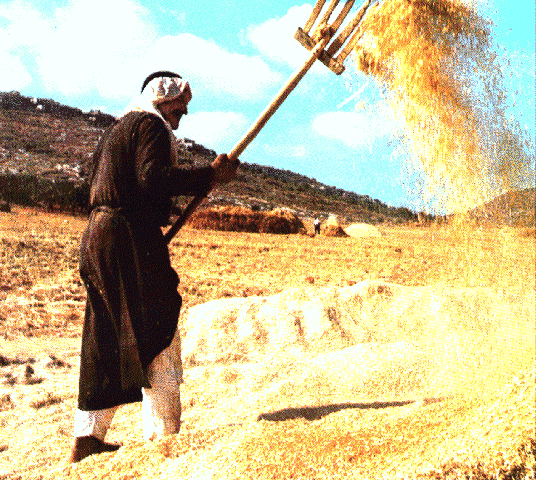
7 I will winnow them with a winnowing fork at the city gates of the land.
I will bring bereavement and destruction on my people, for they have not changed their ways.
8 I will make their widows more numerous than the sand of the sea.
At midday I will bring a destroyer against the mothers of their young men;
suddenly I will bring down on them anguish and terror.
9 The mother of seven will grow faint and breathe her last.
Her sun will set while it is still day; she will be disgraced and humiliated.
I will put the survivors to the sword before their enemies,” declares the LORD.

10 Alas, my mother, that you gave me birth, a man with whom the whole land strives and contends!
I have neither lent nor borrowed, yet everyone curses me.

11 The LORD said, 
“Surely I will deliver you for a good purpose; surely I will make your enemies plead with you in times of disaster and times of distress.
12 “Can a man break iron - iron from the north - or bronze?
13 “Your wealth and your treasures I will give as plunder, without charge,
because of all your sins throughout your country.
14 I will enslave you to your enemies in a land you do not know,
for my anger will kindle a fire that will burn against you.”

15 LORD, you understand; remember me and care for me.
Avenge me on my persecutors. You are long-suffering - do not take me away; think of how I suffer reproach for your sake.
16 When your words came, I ate them; they were my joy and my heart’s delight, for I bear your name, LORD God Almighty.
17 I never sat in the company of revelers, never made merry with them;
I sat alone because your hand was on me and you had filled me with indignation.
18 Why is my pain unending and my wound grievous and incurable?
You are to me like a deceptive brook, like a spring that fails.

19 Therefore this is what the LORD says:
“If you repent, I will restore you that you may serve me;
if you utter worthy, not worthless, words, you will be my spokesman.
Let this people turn to you, but you must not turn to them.
20 I will make you a wall to this people, a fortified wall of bronze;
they will fight against you but will not overcome you,
for I am with you to rescue and save you,” declares the LORD.
21 “I will save you from the hands of the wicked and deliver you from the grasp of the cruel.”


TODAY IN THE WORD
As we study Jeremiah, it’s hard sometimes to understand how one generation could be judged for previous generations’ sin. A little background might help.
Although Josiah and his reforms were very good, Manasseh, Josiah’s father, was one of Judah’s most wicked kings ... and there were some pretty bad ones! Manasseh not only tolerated Canaanite cults, he welcomed them. As if occult and sexually perverse rites weren’t enough, there was human sacrifice - including royal family members. We read in 2 Kings 21:16 that “Manasseh shed so much innocent blood that he filled Jerusalem from end to end” and led many others into sin. And apparently they weren’t inclined to change their ways.
Today’s passage refers to a time after Josiah’s short-lived reforms. This tells us that the people had a chance to repent, but they refused. So as we read about the judgment that came upon Judah, we must remember that there had been ample time for repentance and forgiveness.
Finally, however, there comes a time for justice and judgment. But the Lord takes no delight in this judgment. In verse 5, the Lord lamented His people’s destruction, even though they brought it on themselves. The picture of a widow grieving her sons is surely gripping (vv 8–9). Although this may refer to an actual widow, Jerusalem was sometimes called the “mother-city” of Judah, and her “sons” were the inhabitants.
It’s no wonder Jeremiah rued the day of his birth (v 10). It would have been better to have remained unborn. Yet notice how quickly the Lord assured Jeremiah (v 11).
APPLY THE WORD
Sometimes the pain of life can be almost overwhelming. Maybe you have also “lamented” the day you were born.

20110718

Jeremiah 14

This is the word of the LORD that came to Jeremiah concerning the drought:
2 “Judah mourns, her cities languish;
they wail for the land, and a cry goes up from Jerusalem.
3 The nobles send their servants for water; they go to the cisterns
but find no water. They return with their jars unfilled;
dismayed and despairing, they cover their heads.
4 The ground is cracked because there is no rain in the land;
the farmers are dismayed and cover their heads.
5 Even the doe in the field eserts her newborn fawn 
because there is no grass. 6 Wild donkeys stand on the barren heights
and pant like jackals; their eyes fail for lack of food.”

7 Although our sins testify against us, do something, LORD, for the sake of your name.
For we have often rebelled; we have sinned against you.
8 You who are the hope of Israel, its Saviour in times of distress,
why are you like a stranger in the land, like a traveller who stays only a night?
9 Why are you like a man taken by surprise, like a warrior powerless to save?
You are among us, LORD, and we bear your name; do not forsake us!
10 This is what the LORD says about this people:
“They greatly love to wander; they do not restrain their feet.
So the LORD does not accept them; he will now remember their wickedness and punish them for their sins.”
11 Then the LORD said to me, “Do not pray for the well-being of this people. 12 Although they fast, I will not listen to their cry; though they offer burnt offerings and grain offerings, I will not accept them. Instead, I will destroy them with the sword, famine and plague.”
13 But I said, “Alas, Sovereign LORD! The prophets keep telling them, ‘You will not see the sword or suffer famine. Indeed, I will give you lasting peace in this place.’”
14 Then the LORD said to me, “The prophets are prophesying lies in my name. I have not sent them or appointed them or spoken to them. They are prophesying to you false visions, divinations, idolatries and the delusions of their own minds. 15 Therefore this is what the LORD says about the prophets who are prophesying in my name: I did not send them, yet they are saying, ‘No sword or famine will touch this land.’ Those same prophets will perish by sword and famine. 16 And the people they are prophesying to will be thrown out into the streets of Jerusalem because of the famine and sword. There will be no one to bury them, their wives, their sons and their daughters. I will pour out on them the calamity they deserve.
17 “Speak this word to them:
“‘Let my eyes overflow with tears night and day without ceasing;
for the Virgin Daughter, my people, has suffered a grievous wound, a crushing blow.
18 If I go into the country, I see those slain by the sword;
if I go into the city, I see the ravages of famine.
Both prophet and priest have gone to a land they know not.’”
19 Have you rejected Judah completely? Do you despise Zion? Why have you afflicted us so that we cannot be healed?
We hoped for peace but no good has come, for a time of healing but there is only terror.
20 We acknowledge our wickedness, LORD, and the guilt of our ancestors;
we have indeed sinned against you.
21 For the sake of your name do not despise us; do not dishonour your glorious throne.
Remember your covenant with us and do not break it.
22 Do any of the worthless idols of the nations bring rain? Do the skies themselves send down showers?
No, it is you, LORD our God. Therefore our hope is in you, for you are the one who does all this.

John Gill
Are there any among the vanities of the Gentiles that can cause rain? The blessing wanted; none of the idols of the Gentiles, called vanities, because it was a vain thing to apply to them, or hope for anything from them, none of these could give a shower of rain; though the name of one of their idols was Jupiter Imbrius, or Pluvius, the god of rain, yet he could not make nor give a single drop; as Baal, in the times of Ahab, when there was a drought, could not.
Or can the heavens give showers? From whence they descend, and which are the second causes of rain; even these could not of themselves, and much less Heathen deities.
Art not thou he, O Lord our God? The everlasting and unchangeable He, or I AM, our covenant God and Father, thou, and thou only, canst give rain; this is the peculiar of the great God himself; see Acts 14:17. Therefore we will wait upon thee; for rain, by prayer and supplication, and hope for it, and wait the Lord's own time to give it: for thou hast made all these things; the rain and its showers, who have no other father than the Lord, Job 38:28, also the heavens from whence it descends, and the earth on which it falls, are made by him, who restrains and gives it at pleasure.
(Pausanias makes mention of an image of Jupiter Pluvius, and of altars erected to him in various places ... and in India, as Apollonius Tyanaeus relates, ... was a tub, which in time of drought they opened; from whence, as they pretended, clouds came forth and watered all the country. Near Rome was a stone called Lapis Manalis, which being brought into the city, was said to cause rain. A like fable is told of water being in the forehead of Jupiter Lycaeus, which being shook by an oaken branch in the hand of a priest, gathered clouds, and produced plentiful showers of rain when wanted; but these, with others, are all fables and lies. ...)

20110717

Jeremiah 13

1 This is what the LORD said to me: “Go and buy a linen belt and put it around your waist, but do not let it touch water.”
2 So I bought a belt, as the LORD directed, and put it around my waist.
3 Then the word of the LORD came to me a second time: 4 “Take the belt you bought and are wearing around your waist, and go now to Perath and hide it there in a crevice in the rocks.” 5 So I went and hid it at Perath, as the LORD told me.
6 Many days later the LORD said to me, “Go now to Perath and get the belt I told you to hide there.” 7 So I went to Perath and dug up the belt and took it from the place where I had hidden it, but now it was ruined and completely useless.
8 Then the word of the LORD came to me: 9 “This is what the LORD says: ‘In the same way I will ruin the pride of Judah and the great pride of Jerusalem. 10 These wicked people, who refuse to listen to my words, who follow the stubbornness of their hearts and go after other gods to serve and worship them, will be like this belt - completely useless! 11 For as a belt is bound around the waist, so I bound all the people of Israel and all the people of Judah to me,’ declares the LORD, ‘to be my people for my renown and praise and honor. But they have not listened.’
 
12 “Say to them: ‘This is what the LORD, the God of Israel, says: Every wineskin should be filled with wine.’ And if they say to you, ‘Don’t we know that every wineskin should be filled with wine?’ 13 then tell them, ‘This is what the LORD says: I am going to fill with drunkenness all who live in this land, including the kings who sit on David’s throne, the priests, the prophets and all those living in Jerusalem. 14 I will smash them one against the other, parents and children alike, declares the LORD. I will allow no pity or mercy or compassion to keep me from destroying them.’”
15 Hear and pay attention, do not be arrogant, for the LORD has spoken.
16 Give glory to the LORD your God before he brings the darkness,
before your feet stumble on the darkening hills.
You hope for light, but he will turn it to utter darkness and change it to deep gloom.
17 If you do not listen, I will weep in secret because of your pride;
my eyes will weep bitterly, overflowing with tears, because the LORD’s flock will be taken captive.
18 Say to the king and to the queen mother,
“Come down from your thrones, for your glorious crowns will fall from your heads.”
19 The cities in the Negev will be shut up, and there will be no one to open them.
All Judah will be carried into exile, carried completely away.
 20 Look up and see those who are coming from the north.
Where is the flock that was entrusted to you, the sheep of which you boasted?
21 What will you say when the LORD sets over you those you cultivated as your special allies?
Will not pain grip you like that of a woman in labour?
22 And if you ask yourself, “Why has this happened to me?” - it is because of your many sins that your skirts have been torn off and your body mistreated.
23 Can an Ethiopian change his skin or a leopard its spots?
Neither can you do good who are accustomed to doing evil.
24 “I will scatter you like chaff driven by the desert wind.
25 This is your lot, the portion I have decreed for you,” declares the LORD,
“because you have forgotten me and trusted in false gods.
26 I will pull up your skirts over your face that your shame may be seen - 
7 your adulteries and lustful neighings, your shameless prostitution!
I have seen your detestable acts on the hills and in the fields.
Woe to you, Jerusalem! How long will you be unclean?”

TODAY IN THE WORD
Studies show that the more senses are involved in learning, the more likely students are to retain what’s being taught. For example, students who memorize the states’ capitals by means of songs and hand motions are better able to recite them later than students who simply use a written list.
Maybe that’s why God commanded Jeremiah to “act out” some parables. The first acted parable used a linen belt, or waist cloth, which was meant to cling to the body and probably covered the entire lower body. This imagery should have reminded onlookers how they were supposed to cling to the Lord their God.
There’s some debate about the location of Perath (v 4). It could have been along the Euphrates River in Babylon, but that would have involved a 500- to 700-mile trip each way for Jeremiah. More likely it was a town near Anathoth that the Lord chose because its name would remind people of Babylon. Its close location would also enable many to observe Jeremiah.
In any event, when the linen rotted, it was ruined and completely useless. This indicated how the nation had ruined itself and its relationship with God and had become useless because of its spiritual adultery.
Following this acted parable, Jeremiah was directed to perform another one. There may have been a popular saying that went something like, “Everyone knows that wine jars are supposed to be filled with wine ... silly!” Instead, the Lord declared that the people would be filled with wine ... not the sweet, new wine they might have imagined, but rather the powerful wine of God’s wrath. The nation would become “drunk,” impaired in their reasoning because of the coming destruction. In their “intoxication” they would end up killing family members, as they were smashed against one another.
APPLY THE WORD
We don’t have to frequent pagan shrines to have our spiritual discernment impaired. Even seemingly harmless things can eventually weaken our spiritual ability to “see” clearly.


20110716

Jeremiah 12

1 You are always righteous, LORD, when I bring a case before you.
Yet I would speak with you about your justice:
Why does the way of the wicked prosper?  Why do all the faithless live at ease?
2 You have planted them, and they have taken root; they grow and bear fruit.
You are always on their lips but far from their hearts.
3 Yet you know me, LORD; you see me and test my thoughts about you.
Drag them off like sheep to be butchered! Set them apart for the day of slaughter!
4 How long will the land lie parched and the grass in every field be withered?
Because those who live in it are wicked, the animals and birds have perished.
Moreover, the people are saying, “He will not see what happens to us.”

5 “If you have raced with men on foot and they have worn you out, how can you compete with horses?
If you stumble in safe country, how will you manage in the thickets by the Jordan?
6 Your relatives, members of your own family - even they have betrayed you; they have raised a loud cry against you.
Do not trust them, though they speak well of you.
7 “I will forsake my house, abandon my inheritance;
I will give the one I love into the hands of her enemies.
8 My inheritance has become to me like a lion in the forest.
She roars at me; therefore I hate her.

9 Has not my inheritance become to me like a speckled bird of prey that other birds of prey surround and attack?
Go and gather all the wild beasts; bring them to devour.
10 Many shepherds will ruin my vineyard and trample down my field;
they will turn my pleasant field into a desolate wasteland.
11 It will be made a wasteland, parched and desolate before me;
the whole land will be laid waste because there is no one who cares.
12 Over all the barren heights in the desert destroyers will swarm,
for the sword of the LORD will devour from one end of the land to the other; no one will be safe.
13 They will sow wheat but reap thorns; they will wear themselves out but gain nothing.
They will bear the shame of their harvest because of the LORD’s fierce anger.”
14 This is what the LORD says: “As for all my wicked neighbours who seize the inheritance I gave my people Israel, I will uproot them from their lands and I will uproot the people of Judah from among them. 15 But after I uproot them, I will again have compassion and will bring each of them back to their own inheritance and their own country. 16 And if they learn well the ways of my people and swear by my name, saying, ‘As surely as the LORD lives’ - even as they once taught my people to swear by Baal - then they will be established among my people. 17 But if any nation does not listen, I will completely uproot and destroy it,” declares the LORD.
TODAY IN THE WORD
The Palais du Luxembourg sits at the end of the beautiful Luxembourg Gardens in Paris. First built in 1631 for the widow of King Henri IV, the palace became the seat of the French Senate following the French Revolution, and its gardens are a public treasure.
It’s hard to imagine the sickening horror Parisians must have felt when, in 1942, Nazis occupied Paris and used the Palais as the headquarters of the Luftwaffe, the Air Force. The dreaded Third Reich flag replaced the beloved French Tricolor, and Nazi soldiers filled the gardens - even the warning signs telling people to “Keep Off the Grass” were in German. What outrage! What humiliation!
Occupation and desecration at any level are horrible. The poignancy of Jerusalem’s occupation was even more gut-wrenching, however, because it had been set apart as God’s own special possession (Jer. 12:7), or inheritance. Even worse, the people, also God’s inheritance, were roaring at Him like a lion (v 8), so great was their arrogance and wickedness (v 4). They had been originally set apart for God - now because of their horrible sin, they would be set apart for slaughter (v 3). Even the land was forced to suffer judgment (v 4).
The nation of Israel was intended to be a light and a blessing to the surrounding nations (Gen 12:2–3; Isa 42:6). Instead, it had adopted pagan worship of godless creatures. Because of His fundamentally righteous nature, God had no choice but to render judgment.
Today’s passage, however, makes it clear that God had no pleasure in rendering such judgment. Note the use of the pronouns “my” in this passage. The inheritance mentioned in Jeremiah 12:7 refers to both the land and the people, both of which God had to forsake because of the people’s sin. Foreign invaders weren’t just taking over any plot of land, they were invading God’s field and His vineyard - a common metaphor for Israel.
APPLY THE WORD
Have you ever considered that your sin is personally painful to God?

20110715

Jeremiah 11

1 This is the word that came to Jeremiah from the LORD: 2 “Listen to the terms of this covenant and tell them to the people of Judah and to those who live in Jerusalem. 3 Tell them that this is what the LORD, the God of Israel, says: ‘Cursed is the one who does not obey the terms of this covenant - 4 the terms I commanded your ancestors when I brought them out of Egypt, out of the iron-smelting furnace.’ I said, ‘Obey me and do everything I command you, and you will be my people, and I will be your God. 5 Then I will fulfill the oath I swore to your ancestors, to give them a land flowing with milk and honey’ - the land you possess today.”
I answered, “Amen, LORD.”
6 The LORD said to me, “Proclaim all these words in the towns of Judah and in the streets of Jerusalem: ‘Listen to the terms of this covenant and follow them. 7 From the time I brought your ancestors up from Egypt until today, I warned them again and again, saying, “Obey me.” 8 But they did not listen or pay attention; instead, they followed the stubbornness of their evil hearts. So I brought on them all the curses of the covenant I had commanded them to follow but that they did not keep.’”
9 Then the LORD said to me, “There is a conspiracy among the people of Judah and those who live in Jerusalem. 10 They have returned to the sins of their ancestors, who refused to listen to my words. They have followed other gods to serve them. Both Israel and Judah have broken the covenant I made with their ancestors. 11 Therefore this is what the LORD says: ‘I will bring on them a disaster they cannot escape. Although they cry out to me, I will not listen to them. 12 The towns of Judah and the people of Jerusalem will go and cry out to the gods to whom they burn incense, but they will not help them at all when disaster strikes. 13 You, Judah, have as many gods as you have towns; and the altars you have set up to burn incense to that shameful god Baal are as many as the streets of Jerusalem.’
14 “Do not pray for this people or offer any plea or petition for them, because I will not listen when they call to me in the time of their distress.
15 “What is my beloved doing in my temple as she, with many others, works out her evil schemes?
Can consecrated meat avert your punishment?  When you engage in your wickedness, then you rejoice.”

16 The LORD called you a thriving olive tree with fruit beautiful in form.
But with the roar of a mighty storm he will set it on fire, and its branches will be broken.
17 The LORD Almighty, who planted you, has decreed disaster for you, because the people of both Israel and Judah have done evil and aroused my anger by burning incense to Baal.
18 Because the LORD revealed their plot to me, I knew it, for at that time he showed me what they were doing. 19 I had been like a gentle lamb led to the slaughter; I did not realize that they had plotted against me, saying,
“Let us destroy the tree and its fruit; let us cut him off from the land of the living, that his name be remembered no more.”
20 But you, LORD Almighty, who judge righteously and test the heart and mind,
let me see your vengeance on them, for to you I have committed my cause.
21 Therefore this is what the LORD says about the people of Anathoth who are threatening to kill you, saying, “Do not prophesy in the name of the LORD or you will die by our hands” - 22 therefore this is what the LORD Almighty says: “I will punish them. Their young men will die by the sword, their sons and daughters by famine. 23 Not even a remnant will be left to them, because I will bring disaster on the people of Anathoth in the year of their punishment.”

TODAY IN THE WORD (11:18-12:17)
The question that has plagued humans for eons also troubled Jeremiah: “Why do the wicked prosper?” (12:1). How often have you asked this when you hear about some con artist making thousands of dollars off of other’s misfortune? Or wonder why people who openly reject the Lord seem to have everything go their way?
Jeremiah’s interest here wasn’t just theoretical – people were trying to kill him! He cried for the Lord’s vengeance, which might seem surprising from a godly individual like Jeremiah. But more shocking, however, is the Lord’s reply. He seemed to go along with Jeremiah’s plan!
It helps to keep a few things in mind here. First, Jeremiah’s cry was unfiltered. He was profoundly disturbed! These were no strangers; they were from his own town (v 21). Second, in his pain, Jeremiah turned to the Lord. He wasn’t savouring his own “sweet revenge,” but he looked instead to the righteous Judge (v 20). Third, Jeremiah’s enemies were also the Lord’s enemies–these people had repeatedly rejected God. It’s likely they sought to kill Jeremiah because he rightly prophesied that surrender to Babylon was God’s will. So the Lord’s promise to “bring disaster” (v 23) was consistent with judgment for sin.
Jeremiah’s questioning actually went one step further: he pointed out that God Himself planted these people and allowed them to take root, even as they rejected God and thought they were getting away with it.
Instead of answering Jeremiah, God challenged his attitude and “encouraged” him that the worst was yet to come! The “men on foot” (12:5) refers to Jeremiah’s hometown; the “horses” and “thickets by the Jordan” refer to Jerusalem. What Jeremiah had gone through at home was only preparing him for what lay ahead in Jerusalem. This pictures Jesus’ own piercing rejection by his family and in Jerusalem.

APPLY THE WORD
Jeremiah’s example encourages us to ask God the hard questions. But we must recognize that Jeremiah also kept God’s righteous character in sight. Sometimes people use hard questions to justify their rejection of God. Others are afraid even to admit they wrestle with such questions. We need balance. Life confronts us with very challenging situations. Often we won’t have answers, but we can begin by focusing on God’s goodness and mercy, and by praying to glimpse the bigger picture of where we’re headed.

20110714

Jeremiah 10

1 Hear what the LORD says to you, people of Israel. 2 This is what the LORD says:

 “Do not learn the ways of the nations or be terrified by signs in the heavens,
though the nations are terrified by them.
3 For the practices of the peoples are worthless; they cut a tree out of the forest,
and a craftsman shapes it with his chisel.
4 They adorn it with silver and gold; they fasten it with hammer and nails so it will not totter.


5 Like a scarecrow in a cucumber field, their idols cannot speak;
they must be carried because they cannot walk.
Do not fear them; they can do no harm nor can they do any good.”
6 No one is like you, LORD; you are great, and your name is mighty in power.
7 Who should not fear you, King of the nations? This is your due.
Among all the wise leaders of the nations and in all their kingdoms, there is no one like you.

8 They are all senseless and foolish; they are taught by worthless wooden idols.
9 Hammered silver is brought from Tarshish and gold from Uphaz.
What the craftsman and goldsmith have made is then dressed in blue and purple -  all made by skilled workers.
10 But the LORD is the true God; he is the living God, the eternal King.
When he is angry, the earth trembles; the nations cannot endure his wrath.

11 “Tell them this: ‘These gods, who did not make the heavens and the earth, will perish from the earth and from under the heavens.’”
 12 But God made the earth by his power; he founded the world by his wisdom
and stretched out the heavens by his understanding.13 When he thunders, the waters in the heavens roar; he makes clouds rise from the ends of the earth.
He sends lightning with the rain and brings out the wind from his storehouses.

 14 Everyone is senseless and without knowledge; every goldsmith is shamed by his idols.
The images he makes are a fraud; they have no breath in them.
15 They are worthless, the objects of mockery; when their judgment comes, they will perish.
16 He who is the Portion of Jacob is not like these, for he is the Maker of all things,
including Israel, the people of his inheritance - the LORD Almighty is his name.

17 Gather up your belongings to leave the land, you who live under siege.
18 For this is what the LORD says: 

“At this time I will hurl out those who live in this land;
I will bring distress on them so that they may be captured.”

19 Woe to me because of my injury! My wound is incurable!
Yet I said to myself, “This is my sickness, and I must endure it.”
20 My tent is destroyed; all its ropes are snapped.
My children are gone from me and are no more; no one is left now to pitch my tent or to set up my shelter.

21 The shepherds are senseless and do not inquire of the LORD;
so they do not prosper and all their flock is scattered.
22 Listen! The report is coming - a great commotion from the land of the north!
It will make the towns of Judah desolate, a haunt of jackals.

23 LORD, I know that people’s lives are not their own; it is not for them to direct their steps.
24 Discipline me, LORD, but only in due measure - not in your anger, or you will reduce me to nothing.
25 Pour out your wrath on the nations that do not acknowledge you, on the peoples who do not call on your name.
For they have devoured Jacob; they have devoured him completely and destroyed his homeland.


TODAY IN THE WORD
A surprising percentage of Americans looks to the stars for daily guidance. The number of people who read their horoscope has dramatically increased. This growing interest in astrology may feel new, but the practice is quite ancient. The Babylonians loved astrology; they saw meteors, comets, and movement of the planets as omens of good or bad (v 2). But such practices are not appropriate for the people of God! The answers to life can’t be found in the sky, but in the One who made the sky and everything in it!
Humans have a tendency to worship what can be seen. Perhaps that’s why idolatry often occurs together with astrology. There’s a bit of humor in today’s passage, describing how ridiculous idol worship is. For one thing, a piece of wood is randomly selected and then carved and covered with silver and gold. But if the idol weren’t held together with nails, it would fall over! For another thing, idols have to be carried everywhere. There are some accounts of worshippers taking one idol to the temple of another god or goddess for a “visit.” These idols were completely powerless ... they couldn’t speak, walk, or even instruct (v 8). They had no power to hurt (as people feared), or to help (as people hoped).
No wonder Jeremiah broke forth in praise of the Lord God (v 7)! With all power over every nation, the King is worthy of all praise! He is mighty and wise, great and beyond compare, living and eternal! One reminder of the true God reveals the absurdity of idol worship.
Now it was pathetic that pagan nations clung to their idols, but there was absolutely no excuse for His chosen people to tolerate anything to do with idolatry, let alone embrace it.
APPLY THE WORD
In our fallen humanity, we all have a bent toward worshiping the seen instead of the unseen. We may not worship wooden carvings, but we can trust more in our cars and houses than in our faithful heavenly Father who has promised to take care of us. The best way to counter these sinful tendencies is to engage in thoughtful worship of the true God. Take some time to reflect on Jeremiah’s praise in today’s passage. You could also make a list of God’s characteristics and then praise Him accordingly.